
Aquakontakt® & JANZU
Floating. Connection. The freedom of movement and letting go. Aquatic bodywork.
What happens when you no longer have to hold yourself together?
In everyday life, we often don't even realise how much tension we carry.
We rush, adapt, perform, and try to keep up with everything and everyone. And our bodies come along for the ride: we tighten our shoulders, hold our breath, clench our jaws. Sometimes, even when we finally have the opportunity to relax, we find that we simply can't.
In my Pilates sessions, I see again and again that people aren't necessarily weaker or stiffer than they should be. More often, they've learned to constantly brace, hold and control themselves.
But we don't always need more strength or more effort. Sometimes, we need to learn how to hold less tension.
Imagine stress as wearing a wetsuit that's a few sizes too small, all day long.
You try to work, run, dance, play with your children and live your life inside it. You can still move, but something is constantly restricting you. Your movements feel harder, your breathing is more limited, and everything requires just a little more effort.
Now imagine what it would feel like to finally take that tight wetsuit off.
Your chest can move more freely, your breathing may deepen, and suddenly you notice that you don't have to work quite so hard.
For me, aquatic movement meditation is about creating the possibility for this kind of relief.
The water holds you. You don't have to.
Warm water creates a unique environment for the body.
Thanks to buoyancy, we experience our body weight, the load on our joints and the possibilities of movement differently. Water surrounds and supports us, creating space for movements we might find more difficult to allow on land.
During an aquatic movement meditation session, I support and guide you through the water with gentle touch. Slow rocking, stretching and flowing movements may alternate with more dynamic sequences.
There's nothing to achieve and no particular state you need to reach.
Your attention may gradually shift away from the outside world and towards the sensations within your own body. You can experience what it's like not to control every movement, but to allow yourself to be supported by someone else.
Some people experience deep calm. Others discover playfulness, lightness or new ways of experiencing movement. Emotions may arise, or you may simply enjoy floating quietly.
There is no expected experience. No right or wrong way to feel.
Between you and me, held in the embrace of water, everything unfolds in the present moment.
Sometimes I may simply hold you as we become aware of your breathing. Sometimes I may gently move you through the water. If you wish, and the conditions are suitable, you can also explore the experience of moving underwater with the help of a nose clip.
We always begin with how you arrive on that particular day.
Aquakontakt® and JANZU – Two Methods, One Shared Philosophy
My aquatic bodywork draws on the knowledge and experience I've gained through two different methods.
Aquakontakt®
I studied Aquakontakt with Aldea Benedek and successfully completed the training and examination.
Its approach also incorporates elements of Shiatsu and Watsu.
JANZU
I studied JANZU with Ivan González, who has dedicated decades to aquatic movement meditation and shares his experience through international training programmes.
I have also completed the JANZU qualifications required to facilitate sessions independently.
JANZU may involve movements both on the surface and, with mutual consent, underwater. Floating, rhythm, touch and flowing movement can offer a remarkable sensory experience.
JANZU is a dance, almost an art form, emerging between the two of us and the water. While I guide the movement, you can rest, let go and finally turn your attention inward.
For me, these two methods are not separate collections of techniques. I draw on both intuitively and improvisationally, responding to the person I'm working with and the unique qualities of each moment.
A Philosophy That Connects My Pilates Teaching and TRE® Studies
I've been teaching movement for over twenty years, and throughout my work, I've become increasingly interested in the relationship between movement, breathing, awareness and the regulation of tension.
In my somatic approach to Pilates, we don't simply focus on strengthening muscles or performing exercises. We also learn to sense our bodies, recognise when we're using more effort than necessary, and discover easier, more efficient ways of moving.
Recognising tension and developing self-regulation are also important parts of my Pilates teaching.
I'm currently deepening this understanding through my TRE® (Tension & Trauma Releasing Exercises) Provider training, exploring the body's natural tremoring responses, physical reactions to stress and the possibilities of self-regulation.
Pilates, TRE® and aquatic movement meditation are different methods, but for me they are connected by one fundamental question:
How can we create the conditions in which our bodies no longer have to struggle all the time, allowing us to rediscover freedom of movement, rest and connection with ourselves?
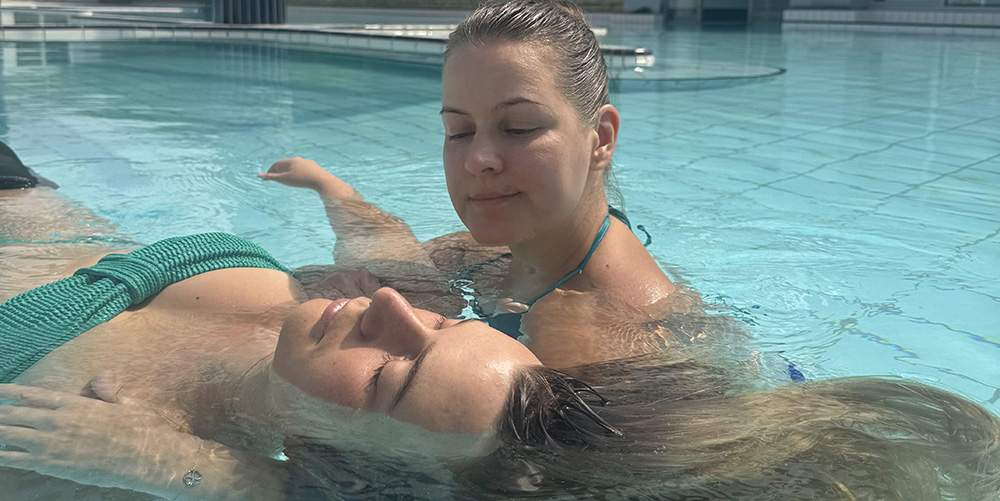
What Happens During an Aquatic Movement Meditation Session?
We begin with a short conversation. I'll explain what to expect in the water, and you'll have the opportunity to share how you're feeling, what you need and anything important I should know.
The time spent floating in the water is approximately 50–55 minutes.
Throughout the session, your comfort, awareness and feedback guide the experience. Underwater movements are entirely optional, and you can always let me know if you'd like something to change.
Afterwards, if you wish, we can spend another 5–10 minutes talking about your experience and anything you noticed.
I recommend allowing at least an hour and a half for the whole experience, so you don't have to rush straight back into everyday life.
Practical Information
Do I need to know how to swim?
No. I'll support you throughout the session, and your face can remain above the water. For underwater movements, we use a nose clip, and we'll discuss this option beforehand.
What should I bring?
A comfortable, well-fitting swimsuit, a towel, slippers and drinking water. If your ears are sensitive, you may also bring suitable swimming earplugs.
I recommend having your last meal approximately 1.5–2 hours before the session and avoiding heavy foods. It's also best to avoid coffee and drinking large amounts of liquid immediately before your session.
Where do sessions take place?
Aquatic movement meditation sessions are available by prior arrangement in suitably heated thermal pools in Budapest or in a private pool.
We'll choose the location and time together, depending on availability.
Session fee: 20,000 HUF
The fee does not include bath admission or private pool rental costs.
Bookings are confirmed upon advance payment. A 24-hour cancellation policy applies.
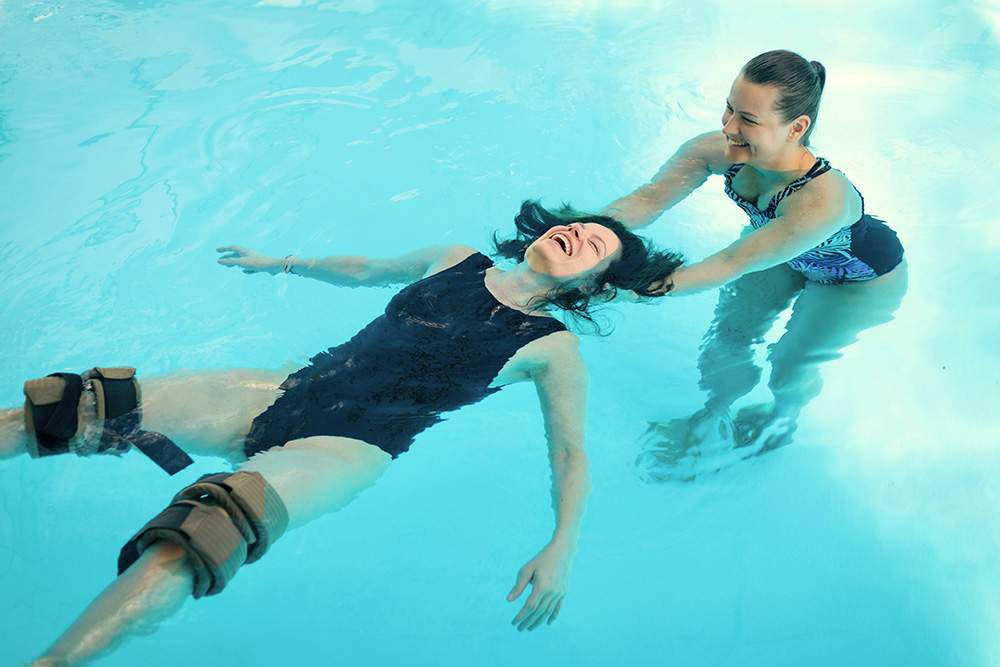
Safety & Suitability – Contraindications
Your safety is my first priority during aquatic movement meditation. Certain health conditions may make this experience unsuitable, and in these circumstances, I cannot responsibly offer a session.
Please read the following information carefully before booking.
Conditions That Exclude Participation
I am unable to offer aquatic movement meditation sessions if any of the following apply to you:
- Epilepsy or another condition involving seizures or loss of consciousness.
- Schizophrenia or another diagnosed psychotic disorder, or a current severe psychiatric crisis.
- Being under the influence of alcohol, recreational drugs or other substances that affect your state of consciousness, including being hungover.
- Fever, acute infectious illness, contagious skin conditions or significant open wounds.
- Severe or poorly controlled cardiovascular or respiratory conditions.
- Recent surgery, acute injury or any medical condition for which immersion in warm water is contraindicated.
- Uncontrolled urinary or faecal incontinence.
- Any condition that prevents conscious cooperation, communication or safe participation in the water.
Conditions Requiring Prior Consultation
Certain health conditions require an individual assessment before participation and, where appropriate, medical approval. These include:
- Ongoing psychiatric treatment or medication that affects alertness or consciousness.
- Significant blood pressure problems, recurring dizziness or a tendency to faint.
- Cervical spine conditions, joint instability or other significant musculoskeletal concerns.
- Ear conditions, eardrum problems or any condition that restricts underwater immersion.
- Pregnancy, particularly where medical complications or additional risks are present.
- Any other medical condition or medication that could affect your ability to participate safely in warm water.
If any of the exclusion criteria above apply to you, please do not book an aquatic movement meditation session.
If you're unsure whether this experience is suitable for you, please contact me before booking. In some circumstances, I may ask you to seek medical advice first.
When completing the booking form, you'll be asked to confirm that you've read the contraindications and that none of the exclusion criteria apply to you.
Aquatic movement meditation is not a medical or psychotherapeutic treatment and does not replace professional healthcare.
Booking
If you'd like to experience the supportive qualities of water and discover a different way of sensing and connecting with yourself, I'd love to welcome you.
You can book your session using the form below.
Anikó Lakos
Aquakontakt® & JANZU Aquatic Movement Meditation Facilitator
“Water is infinitely soft, yet it can make its way through earth and mountains.
In this, we see how softness ultimately prevails over hardness.”
— Lao Tzu